Purple / Case study 03
Product Page Architecture
Retaining upsell opportunities without the cognitive overhead.
The challenge
Purple was asking customers to choose a mattress and evaluate every relevant cross-sell on the same product page. The page carried too much narrative, too many options, and too many decisions for an already complex purchase.
Context
Why it mattered.
A mattress is an infrequent, high-consideration purchase. Adding bases, bedding, and promotions may increase order value, but presenting everything at once can obscure the primary decision and make the experience harder to understand.
My role
Where I led.
As the sole designer on this initiative, I helped diagnose the experience, synthesized behavioral and market evidence, proposed the new information architecture, and carried the direction through design exploration, prototyping, usability testing, and an A/B test.
01 / Following the breadcrumbs
Site data showed the decline. Research showed us why.
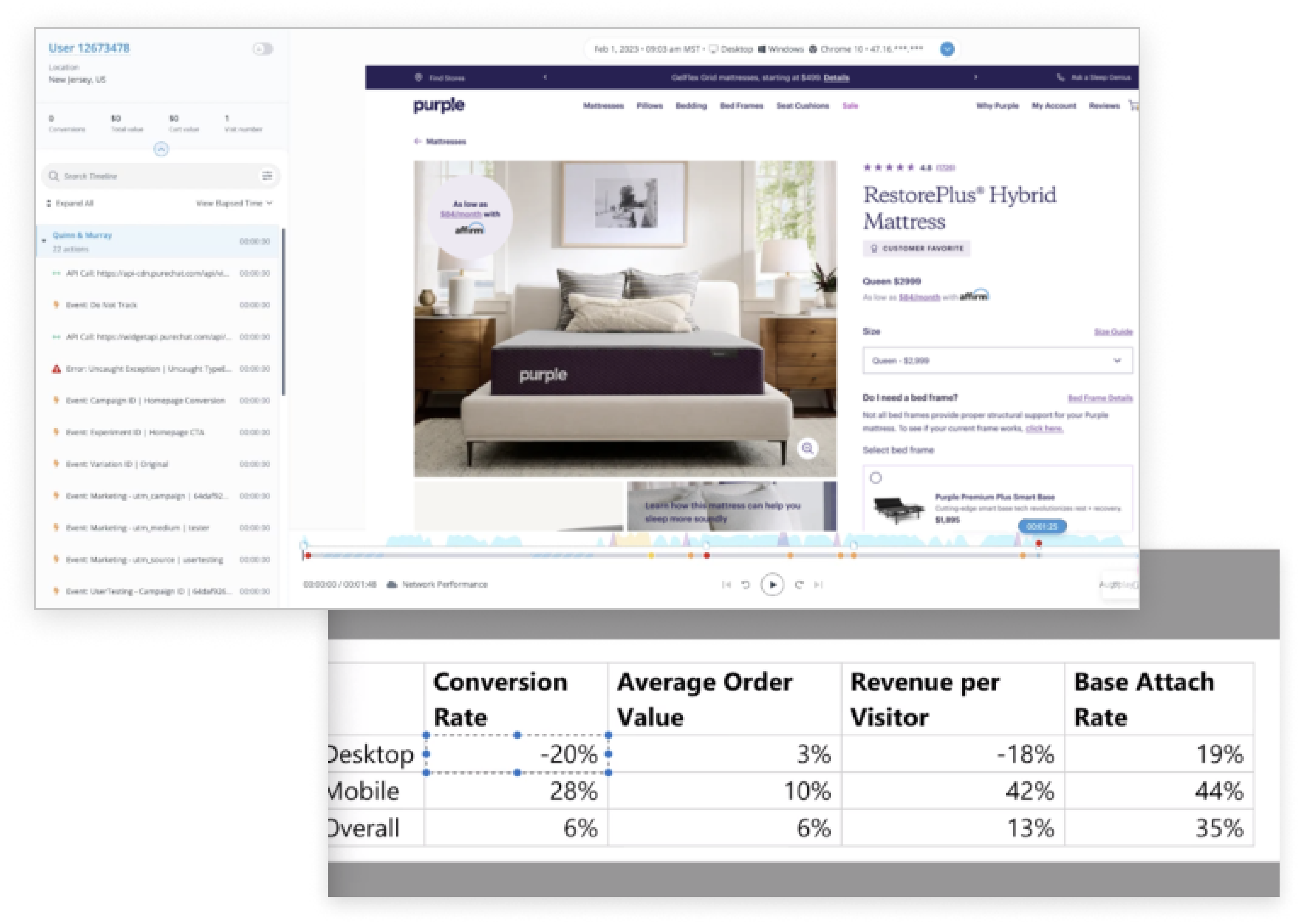
After a redesign by an external agency, upgrades and cross-sells had flattened. Site data showed the decline, but not the cause. I paired quantitative data with user sessions and heat maps from Quantum Metric. The synthesis revealed a clear pattern of hesitation and second guessing with each additional decision we put on the PDP.
02 / The problem with promotions
Every offer competed with the primary job to be done.
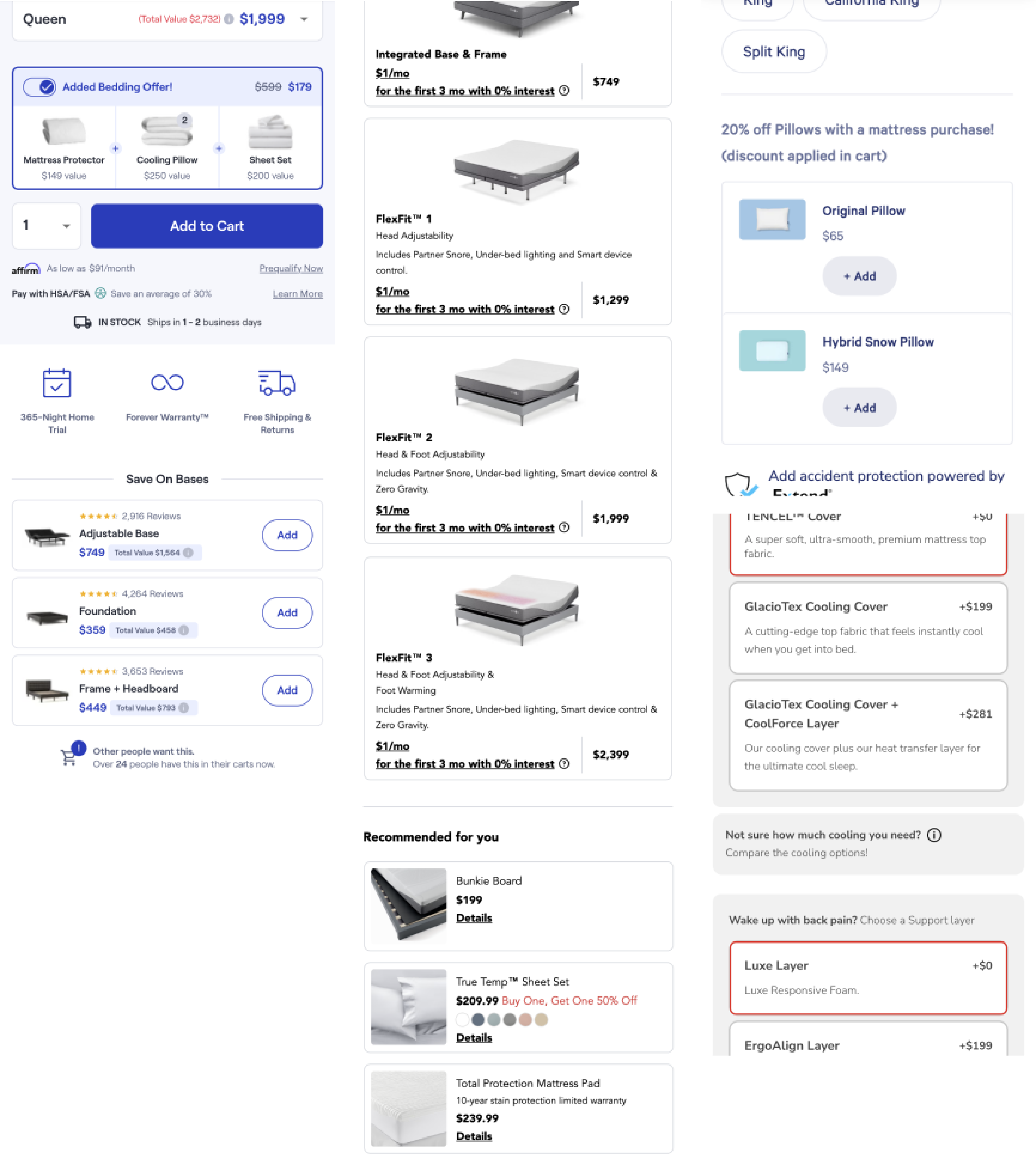
Before Add to Cart, customers had to configure the mattress, consider a bed frame, and evaluate bedding and pillows. The page carried the full sales narrative at once, burying the primary job: choosing a mattress.
03 / The other guys
Our competitors repeated the same mistake.
We audited competitors in and out of market. Most in-category experiences stacked every cross-sell in the PDP, repeating the same overloaded pattern. Looking elsewhere surfaced stronger ways to sequence configuration and add-on decisions.
04 / Beat it up
Prototype. Test. Refine.
I built clickable prototypes and ran unmoderated studies through UserTesting. The feedback exposed weak cues and moments of uncertainty, giving me a focused list to refine and test again.
05 / Revised page architecture
Split one overloaded moment into two focused ones.
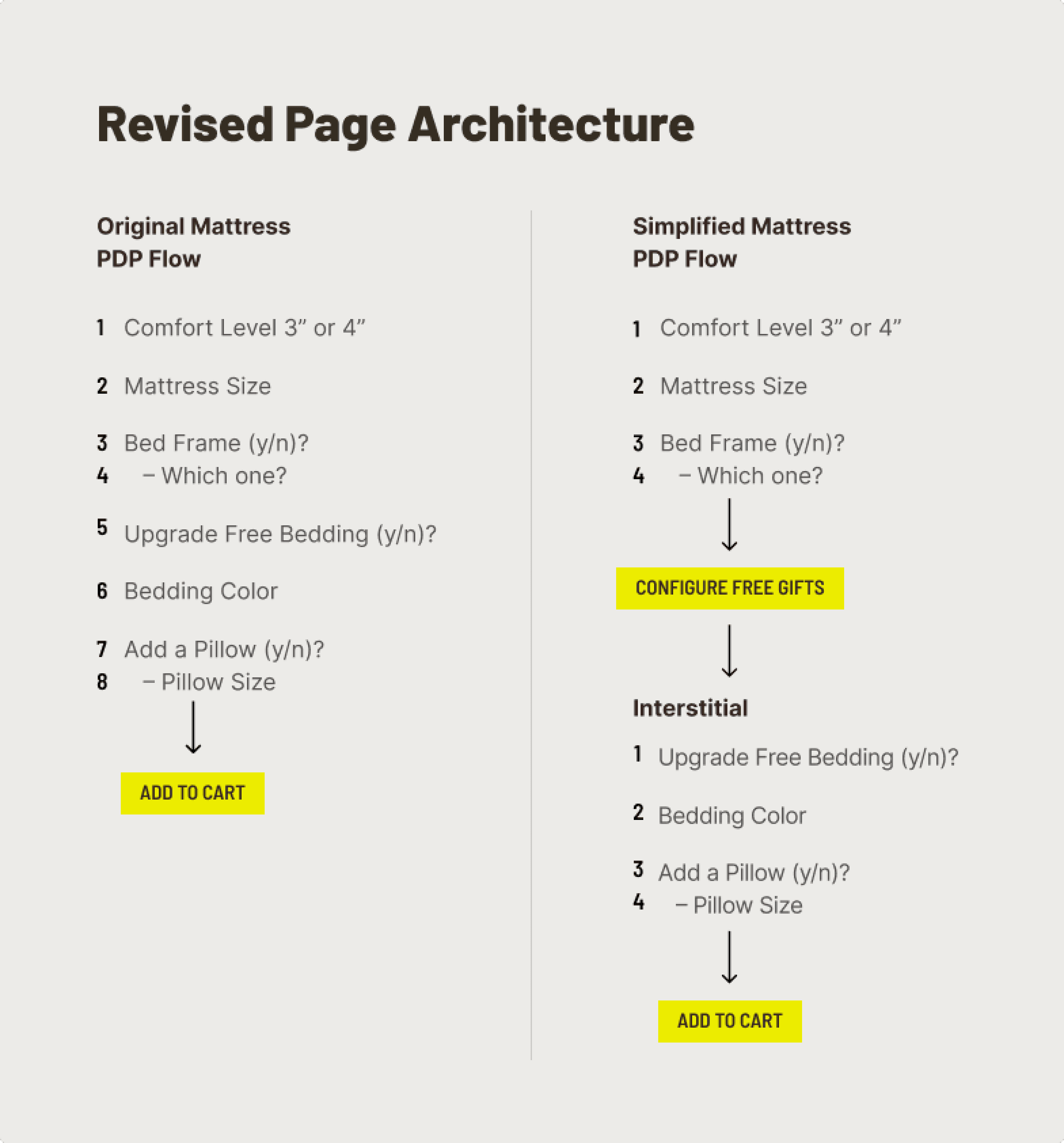
I proposed a post-add-to-cart interstitial for promotions. The PDP would focus on the mattress and bed frame; bedding and pillow decisions would follow once the primary product was in the cart. We preserved the revenue opportunity while cutting the PDP decision load in half.
06 / Watch and learn
The hand-off isn't the end.
We launched the A/B test with only 10% of traffic to the new experience, then 50% and finally 100%. After four weeks live, the results confirmed our hypothesis: customers didn't need fewer choices; they just needed them in the right order.
The proof
61%lift in bedding upgrades
7%increase in average order value
35%increase in bed frames purchased with a mattress
What I took forward
Better questions provide better answers.
- 01
Give every decision a defensible reason
Critique gets easier when a choice connects to observed behavior, a customer need, or a business constraint.
- 02
Treat resistance as a signal
Hesitation around a direction is an invitation to ask better questions—not something to push through with more polish.
- 03
Know what the evidence can prove
Qualitative research explains behavior; experimentation measures impact. Each has a different job.
- 04
Observe the work after it ships
Reaching production isn't proof of success. Real behavior and measurable outcomes close the loop.